



Connecting the disk, corona, and outflows
How do the inner disk and corona connect to the launching and evolution of winds and relativistic jets? My research investigates how plasma thermodynamics and magnetic field structure determine when these outflows emerge and how they appear in observations.
What I’ve shown
In a collaboration with observers, I developed a theoretical interpretation of the emergence of a radio jet in the changing-look AGN 1ES 1927+654. The multiwavelength observations suggest that the magnetic field dramatically reorganized itself despite a relatively constant gas supply. This work connects magnetic field evolution to an observed jet launch and motivates testing how inner disk thermodynamics shapes the transport of magnetic flux needed to launch and sustain powerful jets.
My work on millimeter emission connects the X-ray corona to an outflow in radio-quiet AGN without jets. I showed that strong magnetic fields prevent the compact X-ray corona from producing the observed millimeter emission. My model instead places this emission in an outflow at larger radii, magnetically connected to but physically distinct from the X-ray corona.
Identifying winds also requires distinguishing escaping gas from orbital motion. I recently proposed that some blueshifted absorption features commonly attributed to ultrafast outflows could instead arise from gas orbiting close to the black hole. This interpretation would substantially revise the inferred energy carried by those winds.
Read more about multiwavelength signatures →
What I’m investigating next
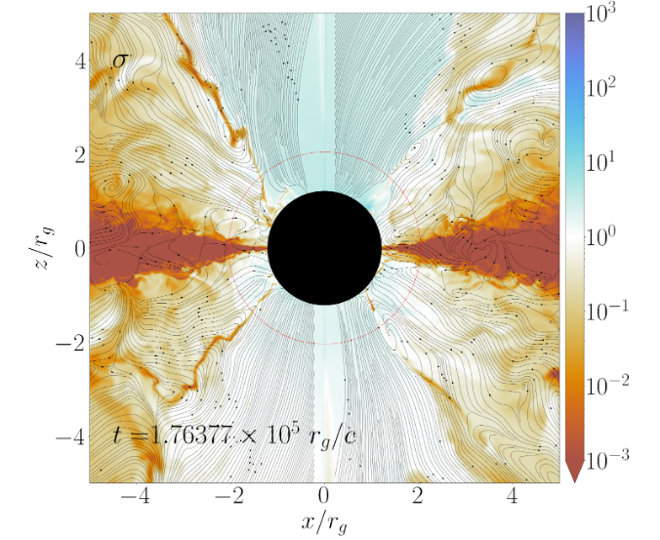
What determines whether a changing accretion flow launches or quenches a jet? I will investigate how electron-proton energy exchange interacts with magnetic field strength and geometry to govern the inner flow and the accumulation of magnetic flux needed for jet launching.
A graduate student I co-supervise is studying how a magnetic field initially wrapped around the black hole’s rotation axis can develop a vertical component that launches a jet when carried onto the event horizon. Connecting this magnetic evolution to the disk’s thermal structure will test which conditions for jet formation are shared across stellar-mass and supermassive black holes.