



Dissipation in Magnetized Plasmas
How do magnetized plasmas divide their power between heating, bulk motion, and particle acceleration? Around accreting black holes, this partition determines the power available for radiation, outflows, and neutrino production.
What I’ve shown
My model for millimeter emission from radio-quiet AGN requires an outflow to carry energy away from the X-ray corona. This outflow requirement raises an energy-budget question: how much power remains available for heating and particle acceleration?
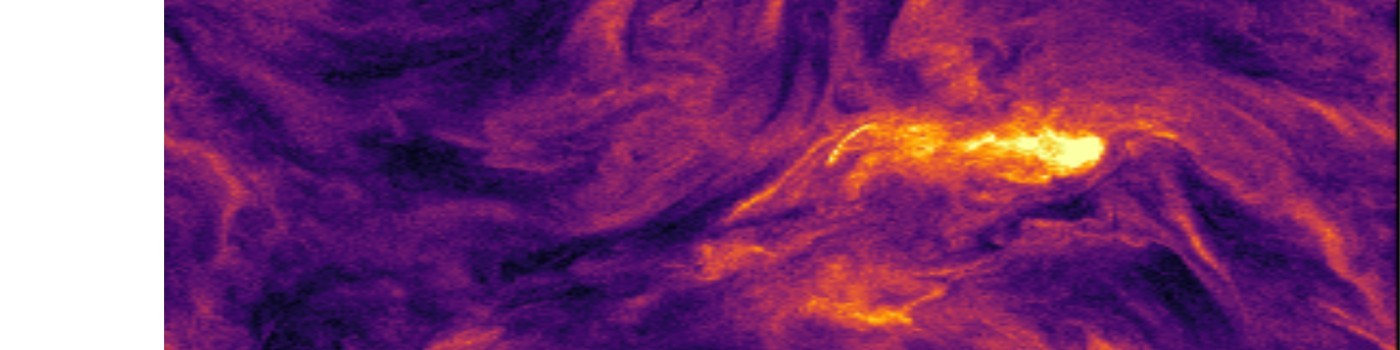
My earlier work addresses the physics behind the trade-off. Using kinetic simulations, I found that turbulence drives outflows reaching 20% of the speed of light at the expense of particle acceleration. Together, these results motivate determining whether the energy carried by coronal outflows limits neutrino production.
Read more in my research note on imbalanced turbulence →
What I’m investigating next
Can a corona accelerate enough protons to explain the observed neutrino emission while simultaneously powering an outflow? I will connect kinetic calculations to my analytic outflowing corona model to determine how much energy remains available to high-energy protons after electron heating and bulk plasma motion.
Radiative cooling could substantially change this energy partition. Building on ongoing collaborative work on strongly cooled turbulence, I will investigate how cooling changes the energy available to outflows and particle acceleration.