



Imbalanced Turbulence
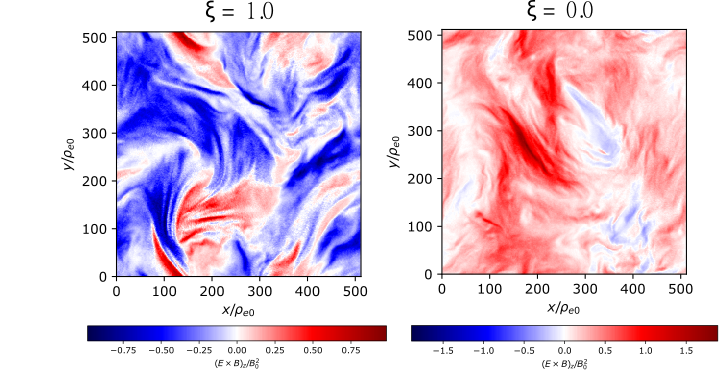
What is imbalanced turbulence?
Typical magnetohydrodynamic models for turbulence in a plasma with a background magnetic field assume equal fluxes of magnetic energy propagating parallel/anti-parallel to the background magnetic field. When the magnetic energy fluxes are not equal, usually due to asymmetric injection of energy, we call the resulting turbulence “imbalanced”.
Why is imbalanced turbulence important?
Many astrophysical objects experience asymmetric energy injection, including pulsar wind nebulae and accretion disk coronae. If imbalanced turbulence looks different than the canonical balanced turbulence, that could have implications for observations of these astrophysical systems.
How do you study imbalanced turbulence?
I use particle-in-cell simulations of a relativistic, collisionless plasma in a periodic simulation domain to study imbalanced turbulence. I drive the plasma with current modes of unequal amplitude that generate Alfvén waves propagating parallel and anti-parallel to the background magnetic field with different amplitudes.
What do you find?
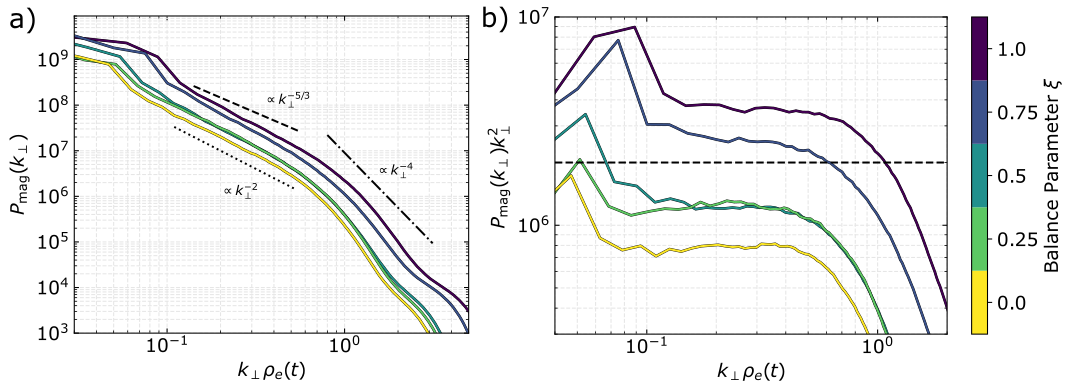
I find that particle acceleration remains efficient even when the driving creating turbulence is strongly imbalanced, although the timescales are significantly longer in the imbalanced case. This finding agrees with quasi-linear theories and could suppress particle acceleration in systems where the light-crossing time of the system is shorter than the acceleration time scale.
I also find that imbalanced driving can launch significant outflows, on the order of 20% the speed of light. The speed of the outflow depends on the magnetization of the plasma. Pending further exploration of the parameter dependence of this effect, this momentum transfer mechanism could present a new wind-driving mechanism, possibly relevant for UltraFast Outflows (UFOs) seen in some active galactic nuclei.
Publication: Monthly Notices of the Royal Astronomical Society (2022)
Presentations: APS DPP 2020/2021