



Nonthermal Emission from the Plunging Region
What is the plunging region?
A spinning black hole has many different important surfaces. The one most people are familiar with is the event horizon: not even light can escape from within this radius. Another important surface is the innermost stable circular orbit (ISCO): within this radius, a massive particle cannot have a stable circular orbit. Instead, particles start “plunging” into the black hole. Orbits change from being circular outside the ISCO to mostly radial inside the ISCO. Everything inside the ISCO is called the plunging region.
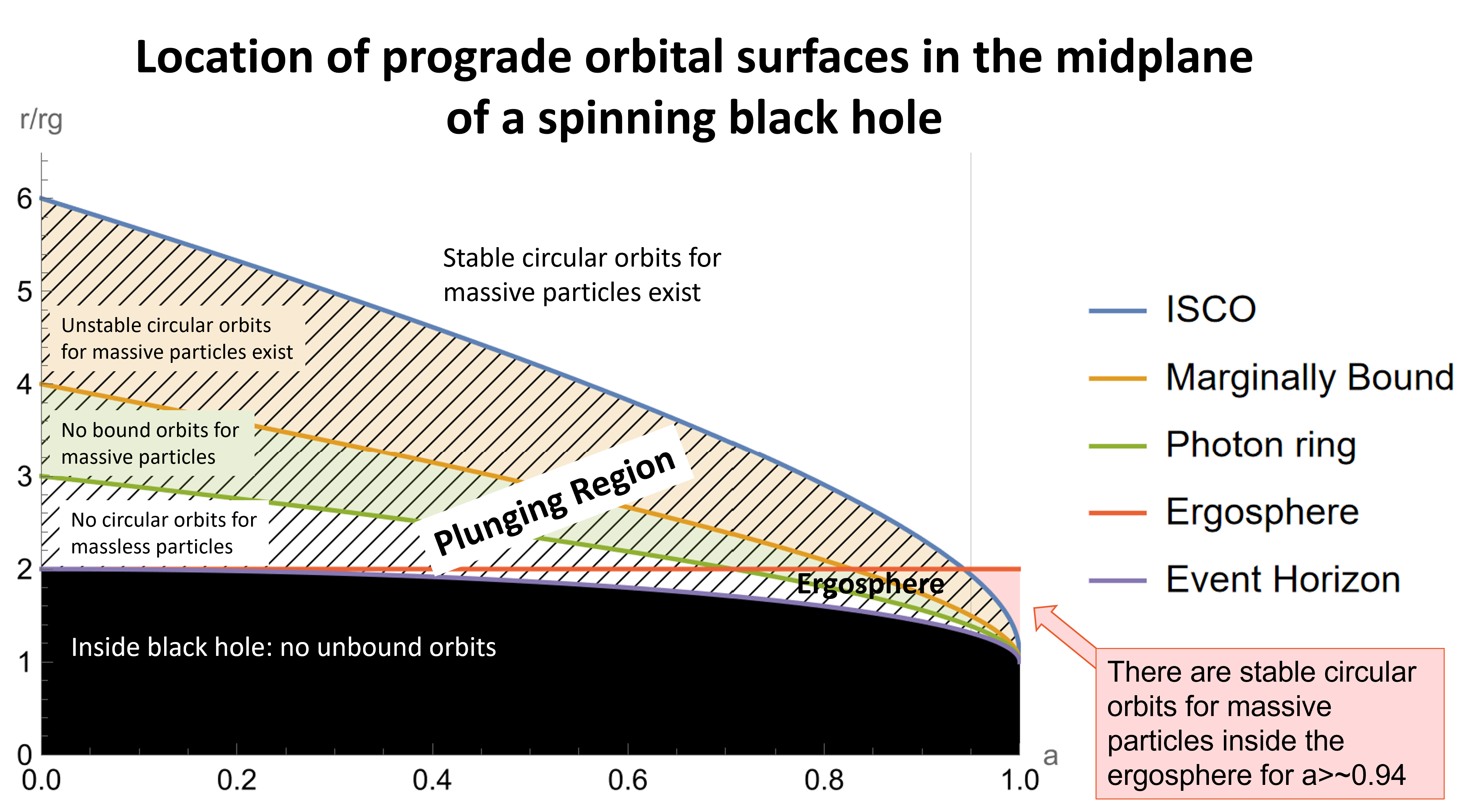
Why is the plunging region interesting?
As you can imagine, the curvature of spacetime is strongest right next to the black hole. Plasma within the plunging region is thus strongly influenced by general relativity. The canonical model for a thin accretion disk (Shakura & Sunyaev 1973) assumes that no light is radiated from within the ISCO. Later models (both analytic and numerical) revise that assumption, but still generally model the plasma as a fluid. However, because the plasma is falling into the black hole so quickly, the fluid assumption can break down and lead to a semi-collisional plasma within the ISCO. Magnetic reconnection can accelerate particles to very high energies that don’t get thermalized before falling into the black hole, leading to a hybrid electron distribution. What would we see from this hybrid electron distribution?
How do you study the plasma in the plunging region?
This project took a semi-analytic route, building an expression for the electron distribution at each radius off of a background model for the density and magnetic field profiles. We used a prescription from particle-in-cell simulations of magnetic reconnection to help build the electron distribution. Once the electron distribution is constructed, we assumed either synchrotron or inverse Compton radiation to get the photon distribution. Then, we raytrace the photons back to a camera to account for general relativistic effects such as Doppler shifting and intensity beaming.
What do you find?
We find that the model reproduces observations well. The hope is eventually to use this model as a way to measure magnetic fields or black hole properties: input an observable and see what model parameters best fit it. Currently, our model trends are washed out by observational variation, so better observations will be needed before we can quantitatively test this model.
Publication: Monthly Notices of the Royal Astronomical Society (2022)