



Luminous Body Embedded in an Accretion Disk
Thermal Torques
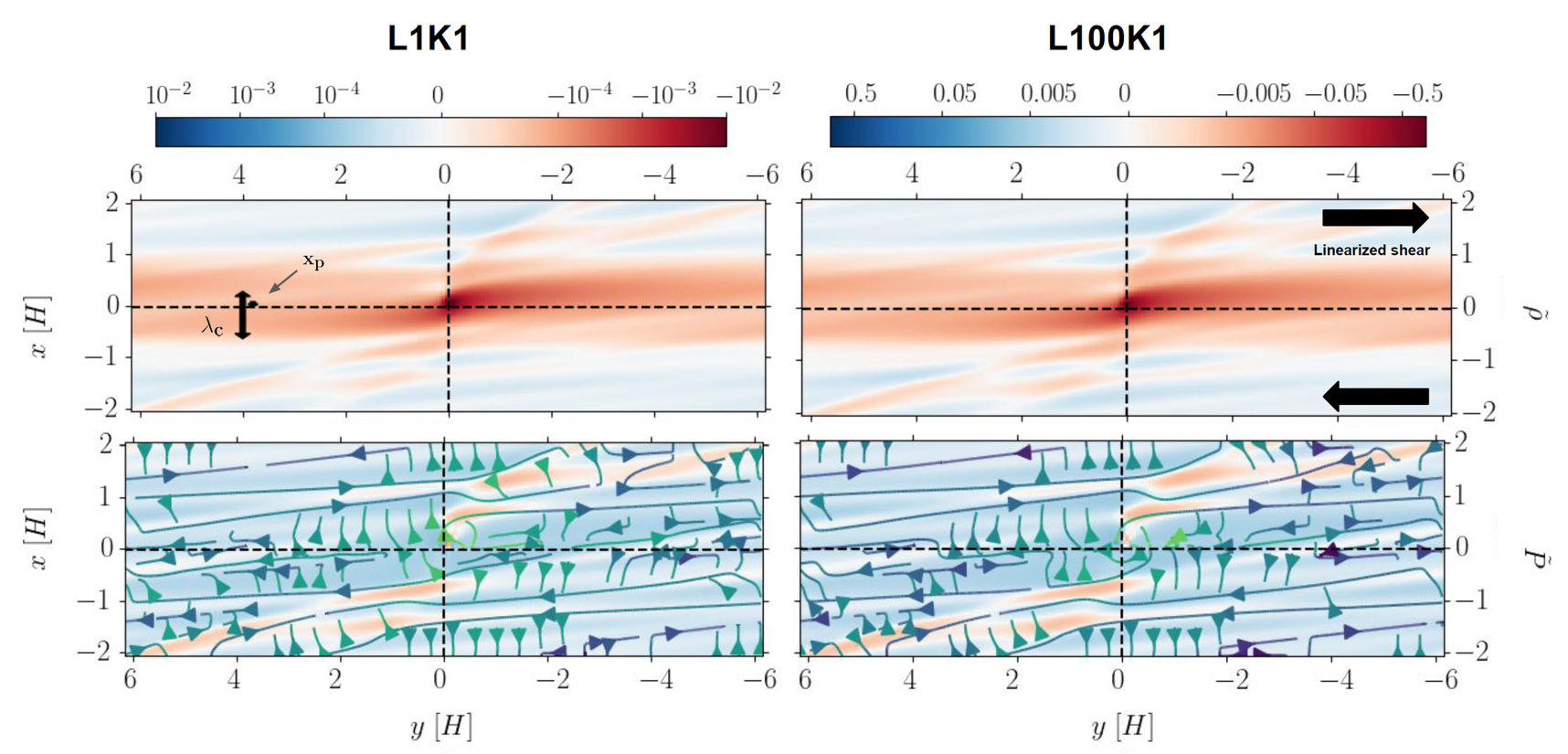
Luminous bodies in an accretion disk–for instance, an accreting planetesimal in a protoplanetary disk–emit radiation that heats up the gas of the disk. This heating results in asymmetric underdensities of gas and thus a net torque on the body, leading to orbital migration of the body. During my summer at the CCA, I worked with Phil Armitage and Yan-Fei Jiang to test the linear theory of this “heating torque”. We found that the linear theory underpredicts the acceleration of the body in the high conductivity regime, and that the theory originally developed for modelling planets in a disk could also be applied to stars or accreting stellar mass black holes embedded in Active Galactic Nucleus disks.
This work was published in the Astrophysical Journal in 2020.